 Sign in

Displaying 1 to 15 of 64 Publications
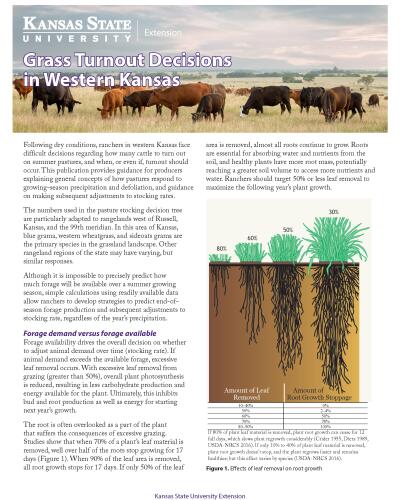
Grass Turnout Decisions in Western Kansas
by Helen Giefer et al.
MF3716
This publication provides guidance for producers explaining general concepts of how pastures respond to growing-season precipitation and defoliation, and guidance on making subsequent adjustments to stocking rates. Color, 4 pages.
Published Date: Apr 2026


Crabgrass: An Alternative Cattle Forage
by Bruno C. Pedreira et al.
MF3644
Publication describes best practices to produce crabgrass from seed to provide grazing and hay to cattle. 4 pages, color.Published Date: Oct 2023
Nutritional Composition of Feedstuffs for Beef Cattle
MF3648
This publication summarizes the nutrient composition of feed ingredients for dietary formulation and evaluation for beef cattle. Feedstuffs considered commonly available to producers across Kansas are included, along with additional ingredients for which composition values are well documented. 12 pages, color.Published Date: Oct 2023

Pasture Management for Horses
by Bruno C. Pedreira Junior I. Yasuoka Teresa L. Douthit
MF3634
Description of best management practices for pastures grazed by horses. Divide pasture into several paddocks so grasses in each area can rest and regrow after grazing. Reserve one area (sacrifice lot) to provide water, hay, and shelter rather than grazing. Other practices include mowing, manure management, fertilizing, and weed control. 4 pages, color.Published Date: Jun 2023
Native Hay Meadow Management
by Bruno C. Pedreira Walter H. Fick
MF1042
Management techniques for establishing and maintaining native hay meadows. 4 pages, color.Revision Date: Oct 2022

Establishing Native Grasses
by Bruno C. Pedreira Walter H. Fick
MF2291
Management techniques for establishing and maintaining native grass stands. 4 pages, 2-color.Revision Date: Oct 2022

Rangeland and Pasture Grasses of Kansas
C567
Identification guide for range and pasture grasses in Kansas. 32 pages, b/w.Revision Date: Oct 2022

Managing the Prussic Acid Hazard in Sorghum
by Shelby M. Gruss et al.
MF3607
Publication describes best practices for grazing and feeding livestock to reduce the risk from a toxin. Sorghum and related plants can produce a poison, prussic acid. Prussic acid, also known as hydrogen cyanide (HCN), can cause acute toxicity and death. 4 pages, color.Published Date: Jun 2022

Red Flag Warning and Fire Weather Information
by Eric Ward
MF2775
Weather is important in conducting a prescribed burn on pastures and range. No burning should be conducted on a Red Flag day. Fire weather information is available online. 2 pages, 2 color.Revision Date: Apr 2022
Enhancing Intensive Early Stocking plus Late-Season Grazing for Stocker Cattle in the Kansas Flint Hills
by Clenton Owensby Walter H. Fick
MF3569
The publication describes a three-year grazing rotation of two years of enhanced intensive early stocking plus late-season grazing followed by one year of season-long grazing at the normal grazing rate. This proved to be a sustainable grazing scheme, which greatly increased profitability for stocker grazing in the Kansas Flint Hills region. 4 pages, color.
Published Date: May 2021

Seed Production Management for Smooth Bromegrass and Tall Fescue
by Stewart Duncan Romulo Pisa Lollato Walter H. Fick
MF924
Publication describes management practices to produce high yields of seeds from smooth bromegrass and tall fescue. Practices include clipping seed stalks when mature, and applying nitrogen in late fall or early winter. 4 pages, color.Revision Date: Apr 2021

Cover Crops Grown Post-Wheat for Forage Under Dryland Conditions in the High Plains
by Sandy Johnson et al.
MF3523
Presents information on species selection, variability in forage production and challenges associated with grazing cover crops. Also provides recommendations for grazing management, determining stocking rates, and other considerations. 8 pages, color.Published Date: Jun 2020

Beef Cattle: Practices to Improve Sustainability
by Jaymelynn Farney et al.
MF3269
Producers can reduce the environmental impact of livestock production while increasing profits by using the practices suggested in this fact sheet. 4-page, color.
Published Date: Aug 2019

Fire and Grasslands
by Carol Baldwin et al.
MF3459
Publication describes the benefits of burning grassland to provide better grazing for livestock and better habitat for wildlife, to control woody plants and weeds, and to reduce the risk of wildfire. 4-page, color.Published Date: Jul 2019
Alternative Burning Strategies: Effects on Cattle Performance, Grassland, and the Environment
by Jaymelynn Farney et al.
MF3251
Compares the effects of patch burning with traditional pasture burning (prescribed burning). Explores the viability of this practice for reducing greenhouse gas emissions from cattle grazing systems. 4-page, color.Published Date: Feb 2019
Displaying 1 to 15 of 64 Publications
