 Sign in

Displaying 46 to 60 of 64 Publications
Managing Kansas Grazinglands for Multiple Benefits
by Will Boyer Larry Huber Gary May
MF2086
Plant growth will provide vegetative cover that intercepts rain, impedes runoff, & ensures a root mass that binds soil, reduces leaching of nutrients, animal wastes, pesticides. 20 p.Revision Date: Jun 2004


Maintaining Grass Waterways
by Kent A. McVay G. Morgan Powell Ray E. Lamond
MF1064
Grass waterways and terraces are important components of a soil and water conservation program aimed at reducing erosion. Waterways often serve as an outlet for runoff from terraces.Revision Date: Apr 2004
Grazing Distribution
by Paul D. Ohlenbusch Joseph P. Harner III
MF515
Grazing distribution is the pattern created by livestock grazing rangeland or pasture. Uniform distribution is needed for long-term management & effective use of forage, & protects water sources.Revision Date: Jan 2003
Prescribed Burning as a Management Practice
by Paul D. Ohlenbusch David C. Hartnett
L815
Burning grassland can recycle nutrients, control weeds & brush, improve grazing distribution, reduce wildfire hazards, improve wildlife habitat, & increase livestock production. 8 p.Revision Date: Mar 2000

Forage Facts Notebook
by Paul D. Ohlenbusch Gary L. Kilgore Dale A. Blasi
S115
Grazing & cattle production information. Topics include grasses, legumes, cereals, silage, hay, pasture & soil management, insects, diseases, prescribed burning, weed & brush management.Published Date: Mar 1999

Controlling Saline Seeps
by Mark Schrock Kyle Mankin Ray E. Lamond
MF2391
Saline seeps, locally known as alkali spots or slick spots, are areas of bare soil or reduced crop production, usually located on a low-lying area. In dry periods, salt crystals may surface.Published Date: Jan 1999
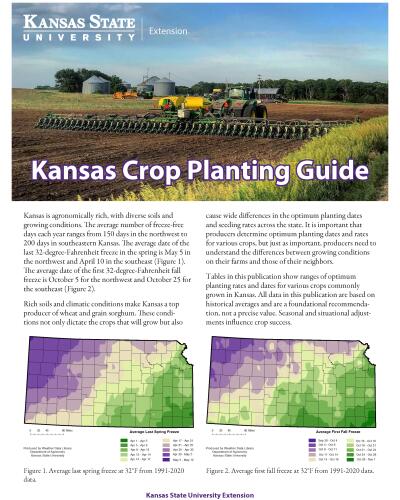
Kansas Crop Planting Guide
by James P. Shroyer et al.
L818
This publication is in revision. The new version should be available soon.
Tables with recommendations for planting dates, rates (pounds of seed/acre), seed spacing, seeds/pound, & test weights for crops such as grains, legumes, grasses, sunflowers, etc. Color, 8 pages.
Revision Date: Nov 1996

Triticale in Kansas
by James P. Shroyer Robert L. Bowden Ray E. Lamond
MF2227
Triticale generally has higher forage yields, but lower quality than wheat, especially when harvested as hay or silage. It has similar crude protein values (20-25%) as wheat when grazed.Published Date: Oct 1996
Prescribed Burning Safety
by Paul D. Ohlenbusch James W. Kunkel
L565
Prescribed burning of pastures and range land to control weeds and brush, has become a major, though potentially dangerous, management tool throughout Kansas.Revision Date: Mar 1996
Prescribed Burning — Planning and Conducting
L664
Planning a burn involves determining what to burn, what precautions to take, and conditions for a successful burn.Revision Date: Mar 1996
Musk Thistle: Identification and Control
by Walter H. Fick Dallas E. Peterson
L231
The musk thistle or nodding thistle Carduus nutans, is usually a biennial or winter annual, but it occasionally occurs as a summer annual. 6-pages, color.Revision Date: May 1995

Large Round Bale Hay Storage
by Randal K. Taylor Dale A. Blasi
MF1066
Lists methods of hay storage. Round bales are not well suited for barn storage. Outdoor storage is practical in low-rainfall areas. Covers, stacking methods, & drainage reduce losses.Revision Date: May 1995

Stocking Rate and Grazing Management
by Paul D. Ohlenbusch Steve L. Watson
MF1118
Grazing management is the art of integrating animals, feed, and other inputs with land, labor, and capital resources.Published Date: Feb 1994

Small Grain Cereals for Forage
by James P. Shroyer Dale L. Fjell Steve L. Watson
MF1072
Small grain cereals (winter wheat, rye, barley, etc.) can be a valuable forage supplement to summer annuals and native grass pastures, and a good primary forage when backgrounding beef cattle.Published Date: Aug 1993
Prescribed Burning Equipment
by Paul D. Ohlenbusch James W. Kunkel Steve L. Watson
L876
Prescribed burning of grassland sometimes requires unique equipment, but often common tools and equipment can be adapted. Equipment is needed to suppress or control fire, & to ignite it.Published Date: Mar 1993
Displaying 46 to 60 of 64 Publications
