 Sign in

Displaying 76 to 89 of 89 Publications
Pesticide Mixtures: Understanding Their Use in Horticultural Production Systems
MF3045
Tank mixing combines two or more pesticides into a single spray solution. Mixing two pesticides may kill more insects and mites. Pesticide mixtures may be more effective on certain types and developmental stages of arthropod pests. 4 p.Published Date: Apr 2012


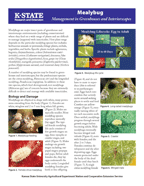
Mealybug: Management in Greenhouses and Interiorscapes
MF3001
Mealybugs are major insect pests of greenhouse and interior environments where they feed on a wide range of plants and are difficult to manage with insecticides. Species are the citrus mealybug, Planococcus citri, longtailed mealybug, Pseudococcus longispinus, and root mealybugs, Rhizoecus spp. 4 p.Published Date: Sep 2011

Twospotted Spider Mite: Management in Greenhouses and Nurseries
MF2997
Information on twospotted spider mites, (Tetranychus urticae) including biology and damage, management, scouting, use of miticides, resistance and resistance mitigation, impact of pesticides on mite populations, and biological management. 8-page, color.Published Date: Jun 2011

Broad Mite and Cyclamen Mite: Management in Greenhouses and Nurseries
MF2938
Broad and cyclamen mites feed on plants in more than 60 plant families, including houseplants, flowers, strawberries, and vegetables. Publication describes methods to control these pests. 4-page, color.Published Date: Nov 2010
Bulb Mites: Management in Greenhouses and Nurseries
MF2939
Bulb mites feed on plants in the lily family, such as amaryllis, crocus, freesia, gladiolus, hyacinth, lily, narcissus, and tulip. Bulb mites are secondary pests of decaying plant matter caused by fungus gnat (Bradysia spp.) larvae or soilborne fungal pathogens. 2-page, color.Published Date: Nov 2010

Fungus Gnat: Management in Greenhouses and Nurseries
MF2937
Fungus gnats, Bradysia spp.,are major insect pests in greenhouses and nurseries. The larva is located within growing medium. They are a problem under moist conditions during propagation, when plant cuttings or plugs are initiating root systems. 4-page, color.Published Date: Sep 2010
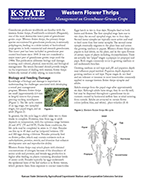
Western Flower Thrips: Management on Greenhouse-Grown Crops
MF2922
Western flower thrips, Frankliniella occidentalis (Pergande) are one of the most destructive insect pests of greenhouse-grown crops. The thrips are small (approximately 2.0 mm in length) insects that possess piercing-sucking mouthparts. 8-page, color.Published Date: Jul 2010

Resistance Management: Resistance, Mode of Action, and Pesticide Rotation
by Raymond A. Cloyd Richard S. Cowles
MF2905
Insects and mites in greenhouses and nurseries are principally managed with pesticides. Continual reliance on pesticides leads to resistance, when pests adapt to survive. 8-page, color.Published Date: Jan 2010

Mulches and Living Organisms
MF2900
Mulch near home foundations, may attract nuisance and/or structural arthropod pests such as centipedes, millipedes, earwigs, ants, termites, and other insects. 2 p.Published Date: Sep 2009

Integrated Pest Management in Greenhouses and Herbaceous Nurseries
by James Quinn Raymond A. Cloyd David Trinklein
MF2892
Integrated pest management (IPM) involves use of cultural, physical, biological, and chemical methods to manage insect and mite pests. Includes inspection, scouting and monitoring. 8-page, color.Published Date: Jul 2009

Borers: Management and Prevention: Home and Horticultural Pests
MF2736
Anti-borer insecticides are best suited for proactive rather than reactive use. Insecticides can be sprayed directly onto tree trunks and larger limbs. 2-page, 2-color.Published Date: Nov 2006

Borers: Common Kansas Species: Home and Horticultural Pests
MF2735
Borers feed unseen beneath bark, destroying irreplaceable cambial and wood tissues of trees and shrubs. Borers are usually larvae of beetles and moths. Photos included. 8-page.Published Date: Oct 2006
Grasshoppers in the Lawn and Garden: Home and Horticultural Pests
L868
Important species include redlegged differential and two-striped grasshoppers. The differential and two-striped grasshoppers are most frequently encountered by home gardeners. 4-page, color.Revision Date: Jun 2005

Springtails
EP124
Springtails are tiny insects that live in areas of high humidity. Their name comes from their ability to use a projection on their abdomen to propel themselves into the air. 2-page, B/W.Published Date: Nov 2004
Displaying 76 to 89 of 89 Publications
