 Sign in

Displaying 31 to 45 of 57 Publications
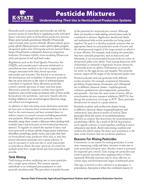
Pesticide Mixtures: Understanding Their Use in Horticultural Production Systems
MF3045
Tank mixing combines two or more pesticides into a single spray solution. Mixing two pesticides may kill more insects and mites. Pesticide mixtures may be more effective on certain types and developmental stages of arthropod pests. 4 p.Published Date: Apr 2012


Agricultural Plant Pest Control, Category 1A
S19
Grasslands, non-crop agricultural lands, production of agricultural crops (including vegetables, feed grains, soybeans and forage, small fruits, tree fruits, nuts, tobacco, peanuts, and cotton). 128 pages, color.Revision Date: Jul 2011

Interior Landscape Pest Management, Category 3C
S33
Production and maintenance of houseplants and other indoor ornamental plants kept or located within structures occupied by humans – houses, apartments, offices, shopping malls, other businesses, and dwellings. 36 pages, color.Revision Date: Jun 2011
Wood Preservation 7F
S155MO
Protect poles, posts, crossties and wood products from damage by insects, fungi, marine organisms, weather deterioration or other wood-destroying agents. Use this University of Missouri manual to prepare for the exam until the Kansas revision is available. https://extension2.missouri.edu/m101Published Date: Mar 2011

Animal Pest Control 1B
by Leah Sandall
S13NE
Animals including beef cattle, dairy cattle, swine, sheep, horses, goats, poultry, and livestock. Places where animals are confined (includes veterinarians who apply pesticides for hire). Use this University of Nebraska manual to prepare for the exam until Kansas revision is available. Print only. Cover art courtesy of U. Nebraska
Published Date: Feb 2011

Forest Pest Control, Category 2: Commercial Pesticide Applicator Training
by Hank Stelzer
S2MO
Forests, forest nurseries, and forest seed-producing areas. Use this University of Missouri manual to prepare for the exam until the Kansas revision is available. Print only. Cover art courtesy of University of Missouri.
Published Date: Feb 2011

Demonstration and Research, Category 10: Pesticide Applicator Manual
S17OK
Individuals who demonstrate to the public the proper techniques for application and use or conduct field research that involves the use of pesticides, or lab personnel engaged in pesticide research under certain environmental conditions. Use this Oklahoma State University manual to prepare for the exam until the Kansas revision is available. Print only.Published Date: Feb 2011

Seed Treatment: Category 4: Commercial Pesticide Applicator Manual
S18IA
This manual is for individuals planning to become certified in commercial pesticide applicator Category 4, Seed Treatment. Print only. Ordered from Iowa. Use this Iowa State University manual to prepare for the exam until the Kansas revision is available. Two pages of information specific to Kansas are included.Published Date: Feb 2011

Broad Mite and Cyclamen Mite: Management in Greenhouses and Nurseries
MF2938
Broad and cyclamen mites feed on plants in more than 60 plant families, including houseplants, flowers, strawberries, and vegetables. Publication describes methods to control these pests. 4-page, color.Published Date: Nov 2010
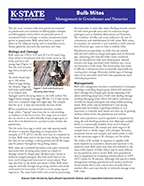
Bulb Mites: Management in Greenhouses and Nurseries
MF2939
Bulb mites feed on plants in the lily family, such as amaryllis, crocus, freesia, gladiolus, hyacinth, lily, narcissus, and tulip. Bulb mites are secondary pests of decaying plant matter caused by fungus gnat (Bradysia spp.) larvae or soilborne fungal pathogens. 2-page, color.Published Date: Nov 2010
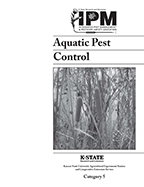
Aquatic Pest Control, Category 5
by Charles D. Lee Dallas E. Peterson Frannie L. Miller
S29
Commercial Applicators Certification. Applied to standing or running water (excludes applicators engaged in public health). Information on aquatic pest control (plants, nuisance animals, parasites and diseases of fish) in accordance with provisions in Federal Insecticide, Fungicide, and Rodenticide Act. 40 pages, B/W.Revision Date: Oct 2010

Stump Treatment Manual, Category 1D
S153
Kansas Commercial Applicators Certification. Cut stumps of woody plants in pastures, rangeland, or lands in conservation reserve. 16-page, b/w.Published Date: Sep 2010

Fungus Gnat: Management in Greenhouses and Nurseries
MF2937
Fungus gnats, Bradysia spp.,are major insect pests in greenhouses and nurseries. The larva is located within growing medium. They are a problem under moist conditions during propagation, when plant cuttings or plugs are initiating root systems. 4-page, color.Published Date: Sep 2010

Resistance Management: Resistance, Mode of Action, and Pesticide Rotation
by Raymond A. Cloyd Richard S. Cowles
MF2905
Insects and mites in greenhouses and nurseries are principally managed with pesticides. Continual reliance on pesticides leads to resistance, when pests adapt to survive. 8-page, color.Published Date: Jan 2010

2008 Kansas Restricted Use Pesticides
MF710
Publication is temporarily unavailable during revision. Publication lists Restricted Use products registered in Kansas for 2006 calendar year. Products are listed in alphabetical order & separated by class: insecticides, herbicides, fungicides, etc.Revision Date: May 2008
Displaying 31 to 45 of 57 Publications
