 Sign in

Displaying 1 to 15 of 120 Publications
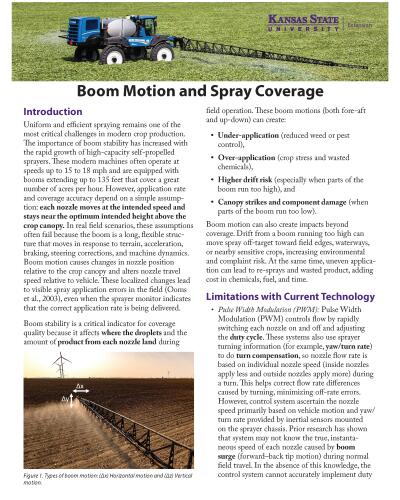
Boom Motion and Spray Coverage
by Ajay Sharda Treman Kaloya Rahul Singh
MF3728
Boom stability is a critical indicator for coverage quality. Setting up equipment and managing driving styles can help ensure even spray coverage and save time and money. 6 pages, color.
Published Date: Jan 2026


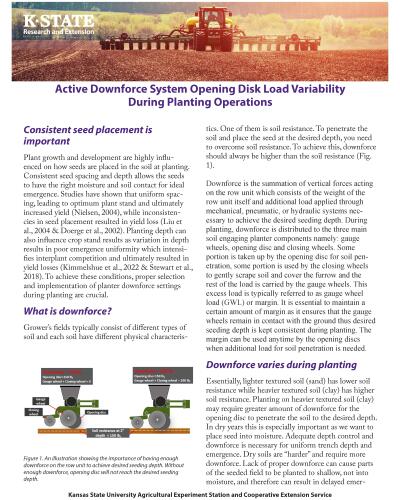
Active Downforce System Opening Disk Load Variability During Planting Operations
by Sylvester Badua Edwin Brokesh Ajay Sharda
MF3681
Consistent seed spacing and depth allow the seeds to have the right moisture and soil contact for ideal emergence. To achieve these conditions, proper selection and implementation of planter downforce settings during planting are crucial. 6 pages, color.
Published Date: Jan 2025
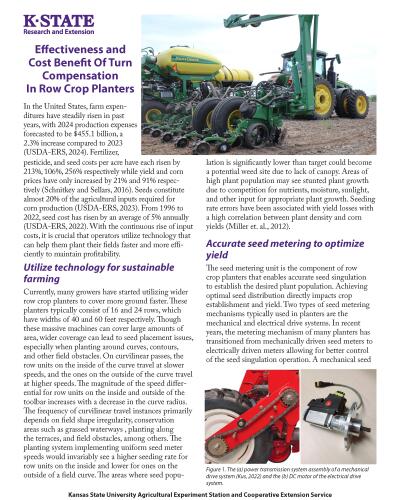
Effectiveness And Cost Benefit Of Turn Compensation In Row Crop Planters
by Sylvester Badua Edwin Brokesh Ajay Sharda
MF3682
With the continuous rise of input costs, it is crucial that operators utilize technology that can help them plant their fields faster and more efficiently to maintain profitability. Using turn compensation systems for planting is one way to achieve this. 6 pages, color.
Published Date: Jan 2025

Interpreting and Using Center Pivot Sprinkler Designs
by Lee Wheeler Carol Baldwin Jeff Davidson
MF3608
Information on how to read an irrigation system operator's manual. 4 pages, color.Published Date: Jul 2022

Thermal infrared Imaging System Usage for Crop Health Assessments
by Ajay Sharda Harman Singh Sangha
MF3561
Thermal imagery is a great tool for crop monitoring, irrigation management, and disease detection. For proper data collection using thermal imagery it is recommended to understand your sensors, carefully select flying speed, altitude, and utilize good ground calibration techniques. Following some of the information presented in this publication could help the user to fully explore its potential. 6 pages, color.Published Date: Feb 2022
Planning and Designing Cattle Feedlots
by James P Murphy Joseph P. Harner III et al.
MF2316
Construction of a new feedlot or expansion of an existing feedlot requires adequate planning and design to maintain the feedlot’s efficiency and profitability. Planning and design information will aid feedlot owners and operators to improve and develop facilities to address human, cattle, and environmental issues, and will result in safe, efficient, and productive feedlots. 12 pages, color.Revision Date: Dec 2021

Cleaning Field Sprayers
MF1089
Sprayer cleaning will prolong life of the sprayer, prevent unnecessary repairs, reduce contamination of surface & groundwater, and eliminate crop injury from equipment contamination. 4 pages, color.Revision Date: Jun 2021

Non-Confined Beef Cattle Feeding Sites
by Herschel George et al.
MF3513
Non-confined feeding sites are used by beef cattle producers to reduce stress on cattle and allow utilization of grass, crop residue, or cover crops. This publication outlines factors to consider when planning for this type of feeding system. 4 pages, color.Published Date: Dec 2020

Feed Biosecurity for Swine Producers
by Cassandra Jones et al.
MF3547
Questions and answers about feed mill biosecurity practices. 4-page, color.Published Date: Nov 2020
Leachate from Silage and Wet Feed Storage
by Joseph P. Harner III et al.
MF3542
As responsible stewards of the environment, producers need to remain aware of the risk of leachate from silage and other wet feed ingredient storages, and take appropriate steps to reduce and manage the leachate/runoff from feed storage and processing areas. This publication describes factors for consideration and best practices to implement. 4 pages, color.Published Date: Oct 2020

Cattle Pen Maintenance
by Will Boyer et al.
MF3511
Pen maintenance plays a vital role in the performance of animals in feedlots. Pen design can provide cattle with resting locations, reduce drying time for lots, and control feedlot runoff. This publication outlines key factors in pen maintenance. 2 pages, color.Published Date: Jun 2020
USDOL Certificate of Training
PM56
Department of Labor certificate required for youth ages 14 and older showing completion of tractor and machinery operation training. Also available as a form-fillable pdf. 5.5" x 8.5” 3-part form, b/w.Revision Date: Feb 2020

Soy-Protein: An Environment-Friendly Seed Lubricant for Pneumatic Row Crop Planters
by Sylvester Badua Ajay Sharda et al.
MF3471
Seed lubricants have been used for many years to keep seeds from clumping together during planting. The most common seed lubricant is a combination of graphite and talc, but it causes hazardous dust. Recent research indicates that soy protein is an effective, economical, and environmentally friendly seed lubricant. This fact sheet provides information to help producers make wise choices about seed lubricants. 4 pages, color.Published Date: Dec 2019

Nozzle Tip Selection for Pulse Width Modulated (PWM) Sprayers
by Jonathan V. Fabula Ajay Sharda
MF3473
Pulse width modulated technology in agricultural sprayers provides a more consistent spray pressure over a wide range of operating speeds. It is important, however, for operators to follow the recommendations of the pesticide companies in terms of nozzle size, droplet spectra, and travel speed, and spray nozzle manufacturer when using a PWM system. This fact sheet includes recommendations and considerations when using the technology in the field. 4 pages, color.Published Date: Dec 2019
Safety Tips for Farming with a Back Injury or Back Problem
by Tawnie Larson et al.
MF3469
Farming safely with a back injury may require adaptations and assistive technologies. This fact sheet from the Kansas AgrAbility Project outlines factors to take into consideration and resources for more information. 2 pages, color.Published Date: Oct 2019
Displaying 1 to 15 of 120 Publications
